Building a Glass Mangrove: How I Constructed a Half-Scale Tree from Borosilicate Tubing
Every large-scale installation has to start somewhere. For Sanctuary of Seeds, it started small, deliberately, strategically small.
When I arrived at the College for Creative Studies in Detroit with the vision of a half-life-scale glass mangrove tree in my head, I knew better than to dive straight into the most complex element. A new studio is an unknown quantity. The equipment has its own personality, its own quirks. Before you ask a studio to help you build something ambitious, you have to learn what it can do.
So I started with the seed pods.
Starting Small: The Mangrove Seed Pods
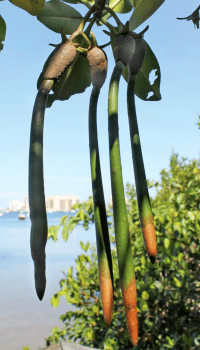

Mangrove seed pods, called propagules in botanical terms, are one of nature's more elegant engineering solutions. They drop from the tree already partially germinated, floating until they find ground to root in. Visually they are long, tapered, almost bullet-shaped. In glass they are a joy to make.
I worked in 10 millimeter standard wall borosilicate tubing. The diameter was ideal, small enough that the natural shape of the tubing already suggested the pod form without requiring extensive manipulation. At the height of my productivity I could produce between 30 and 50 seed pods in a single day. That pace gave me time to settle into the studio, understand the torches, learn the rhythm of the space, while building a body of work that would eventually float above every viewer's head.
I gave myself until spring break to focus entirely on the pods. After that, my full attention would shift to the tree. The clock was running.


Building the Trunk: Why Tubing Over Rod
The decision to build the tree's structure from 2 inch heavy wall borosilicate tubing was both practical and structural. Glass rod, while workable, is solid, it is essentially a single wall of material. Tubing has two walls. That double wall construction gives the piece significantly more structural integrity, which matters enormously when you are building something that needs to support its own branches, withstand transportation, and survive installation in a gallery space.
I began with a hand torch, twisting the trunk section by section. This was slow, meditative work, glass at this scale has its own timeline and it does not respond well to impatience.

Attaching the Branches
Once the trunk was formed the branches came next, and this is where the process gets genuinely complex. I fabricated each branch separately on a Carlisle mini CC torch, annealing them individually in the kilns available at the College. Annealing is the process of slowly cooling glass to relieve internal stress, skip it and your piece will crack, sometimes immediately, sometimes days later when you least expect it.
To attach the branches to the trunk I used a blow hose, a tool that allows me to regulate the air pressure inside the glass as I work, ensuring the connection between branch and trunk is solid and the internal structure stays intact. Each junction is a small engineering problem. Each one has to be solved by hand, in real time, with molten glass.

The tree was annealed in the kilns after the larger branches were attached. But as the tree grew, as the smaller branches multiplied and the overall structure expanded, it eventually became too large to fit inside any available kiln. At that point I transitioned to flame annealing, using the torch itself to slowly and carefully bring the temperature of the glass down. It is a less controlled process than kiln annealing. It requires patience, attention, and a certain amount of trust in your own hands. But it works.
Where the Tree Stands Now
By the end of my time in Detroit the trunk was formed, the major branches were attached, and the tree was ready for its leaves, a process complex enough to deserve its own post entirely. The glass net sculptures that will line the gallery walls were also taking shape alongside the tree, and those too will get their own dedicated story.
What I can tell you is that building this piece, branch by branch, pod by pod, in a Detroit studio while the snow fell outside, was one of the most technically demanding and creatively satisfying experiences of my practice. The tree came down to St. Petersburg, I will discuss the packing process in the following blog post.
Follow along on Instagram to be notified when the next post goes live.

Comments